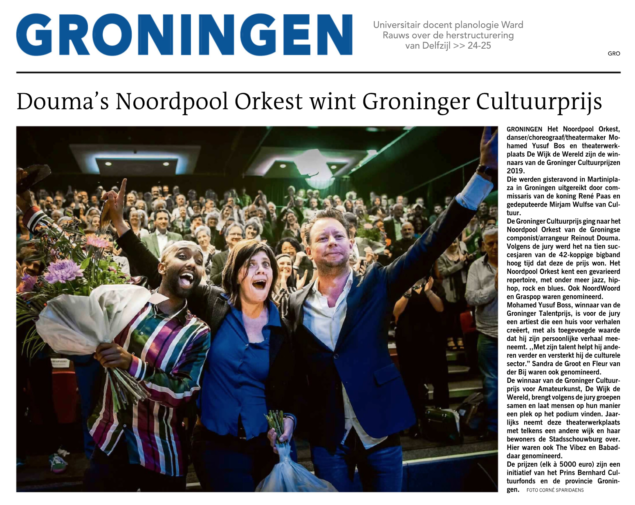
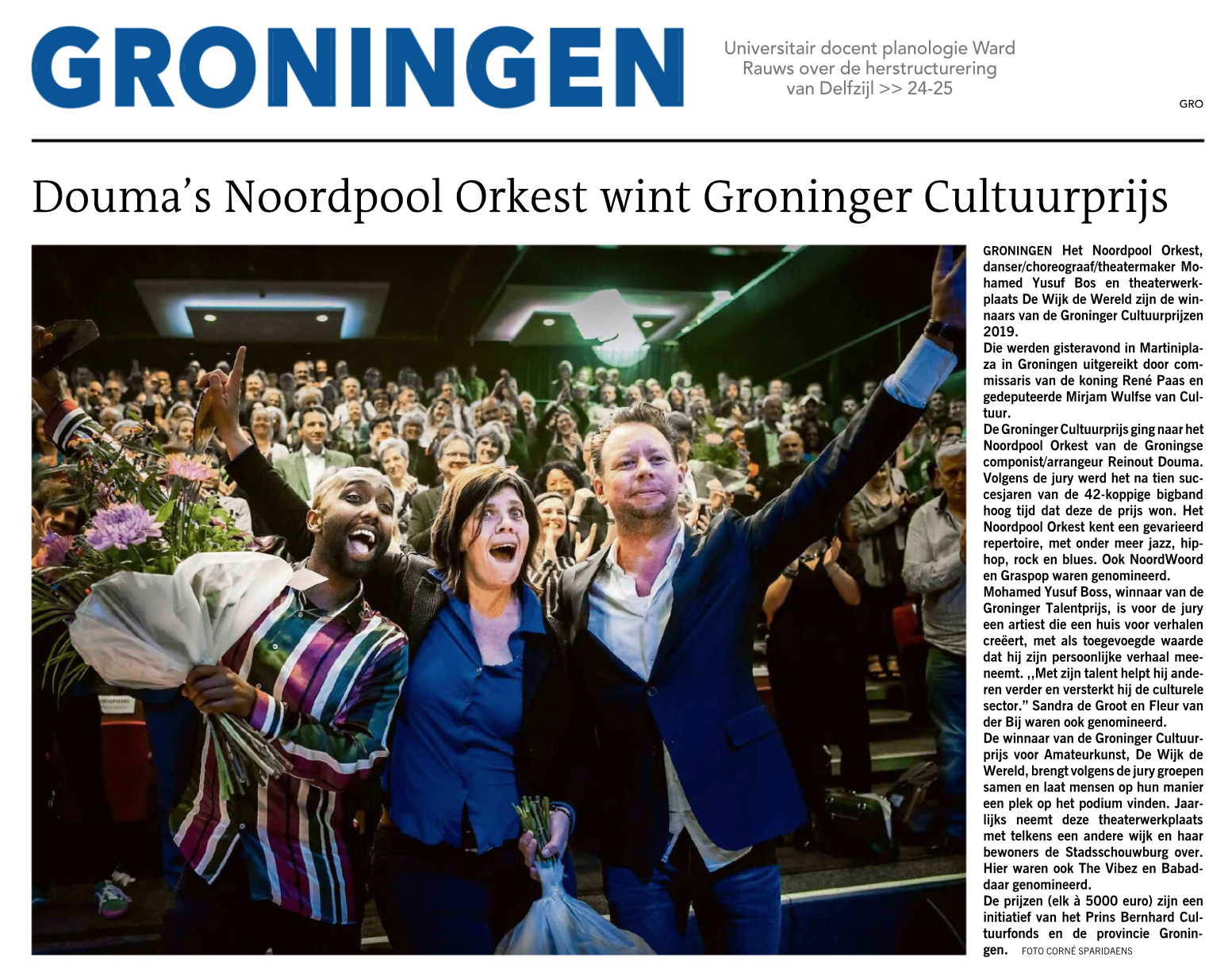
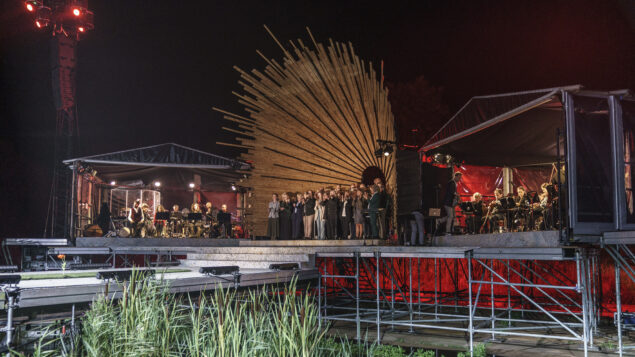
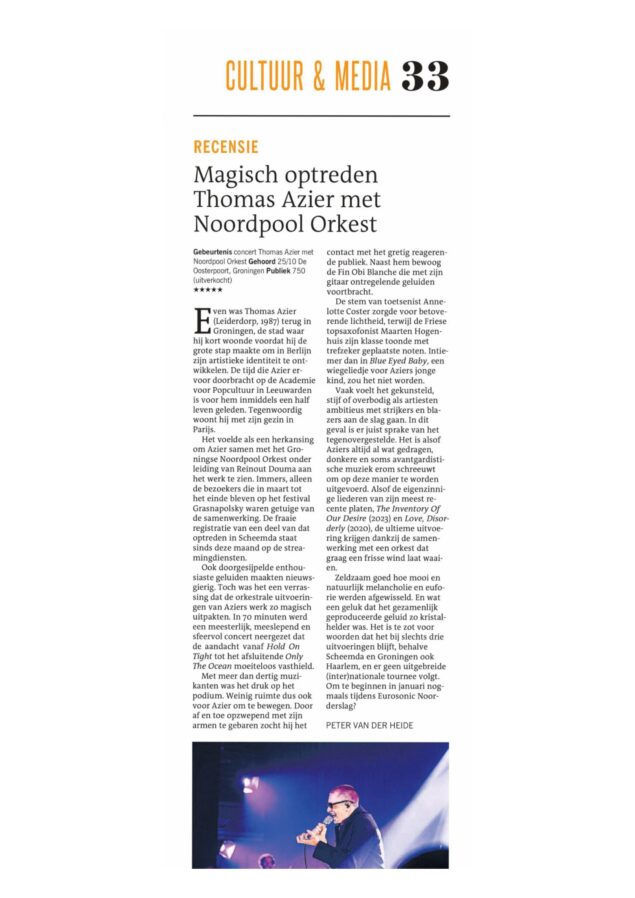
“Reinout Douma componeerde prachtige harmonieën voor koor en liveorkest: filmische soundscapes en flarden van moderne requiems kwamen voorbij. Het enige teleurstellende was dat ze zo kort waren. We hadden meer van die wonderschone klanken willen genieten”.
Saxophone legend Sonny Rollins, one of the most liberated and inventive improvisers in jazz, was once asked why he insisted on playing cheesy popular songs like Don’t Stop The Carnival and the Mexican Hat Dance. His answer – because everyone knows them” – goes to the heart of the creative tension that often exists in a jazz performance, between what is familiar and what is new, between the conventional and the unexpected. If you want to take people on a journey, first you have to get them on the bus.
From the earliest years of the art form, jazz musicians have employed stock harmonic sequences and structures like the 12-bar blues or the AABA song form, not simply because it means that musicians can play together without prior rehearsal, but, more importantly, because the listener will know the tune and therefore can discern the daring act of recomposition that is happening before their ears. What came to be known as the “standard” repertoire in jazz emerged in the 1930s and 40s in the US and consisted of the popular music of the day, mostly Tin Pan Alley songs and Broadway show tunes, which were mercilessly plundered and endlessly reinvented by the great innovators of jazz, from Louis Armstrong to Charlie Parker to John Coltrane. Think of Coltrane’s visceral reinvention of My Favourite Things. The composers of this Great American Songbook are names we still know today – George Gershwin, Cole Porter, Richard Rogers, Jerome Kern – and their subtle, harmonically rich compositions – I’ve Got Rhythm, Night and Day, My Funny Valentine, All the Things You Are – remain the backbone of a contemporary jazz education.
But as the century progressed, and rock’n’roll came to dominate the airwaves, the songs that everyone knew became progressively simpler and, to the jazz musician’s ears, more monotonous and repetitive. Three chords may be sufficient to convey the obvious black-and-white truths about romantic love that seem to obsess commercial pop and rock musicians, but to explore the full spectrum of emotions, to excavate the nuanced complexities of human experience, the pop songs of today rarely provide sufficient harmonic or rhythmic interest to inspire the soloist.
Some have continued therefore to play the old standards, and in the modern era groups like pianist Keith Jarrett’s peerless Standards Trio have continued to navigate new routes through these well-worn structures. More have turned to composing their own tunes, and great jazz composers from Duke Ellington to Wayne Shorter have contributed to a growing repertoire of “jazz standards”, such as Take the A-Train or Footprints.
But the vital task of finding new listeners, of “getting people on the bus”, remains, and increasingly in the contemporary era, jazz musicians have begun covering some of the more sophisticated rock and pop composers. Arch postmodernist piano trio The Bad Plus blazed the trail, covering everything from Abba to Aphex Twin to Nirvana, and Beatles songs such as Blackbird and Yesterday have been enthusiastically co-opted by the jazz community. But perhaps the band most frequently covered by improvisers today are English alt-rock group Radiohead. In 1998, influential US pianist Brad Mehldau led the way when he included a cover of Exit Music (For a Film) from OK Computer (1997) on his album Art of the Trio, Vol. 3. Others, from jazz-meets-hip-hop pioneer Robert Glasper to bluegrass innovator Chris Thile, have followed suit. Later this month, the Raidió Teilifís Éireann (RTÉ) Concert Orchestra, with guest conductor Reinout Douma of the Noordpool Orchestra at the podium, joins their ranks with the Irish premiere of Radiohead – A Jazz Symphony.
Radiohead, one of the bands most covered by improvisers today.
“It’s quite interesting music actually, rhythmically and also harmonically”, says Douma, almost defensively. “Even without the vocals of Thom Yorke.” The Dutch conductor and arranger is speaking to The Irish Times from his music room in Groningen, where he is reviewing his Radiohead arrangements in advance of his trip to Dublin next month.
“A lot of Radiohead songs are not in a 4/4 beat. You have 7/8 in Paranoid Android, and I thought that is really interesting”, he muses. “At first, I was not really into Thom Yorke’s vibe with his voice, or the lyrics, but later on I found out they are actually also quite interesting. In Paranoid Android, [Yorke] says ‘ambition makes you look ugly’ so now I like his lyrics as well! But in the beginning, it was the academic approach of ‘what’s happening actually with these chords?’, ‘what’s happening with these rhythms?’, ‘is it interesting enough for a jazz saxophone player or a trumpeter player to have a solo?’, and I think it is.”
Douma, who founded the Noordpool Orchestra in 2010 to play his own compositions and arrangements, started out studying law in university, “because I thought music is not a way to make a living” but switched to jazz piano and, to make said living, found himself arranging music for shows and cabaret. “And I thought, I don’t want to spend the rest of my life [making] this entertaining music only. I have this background with classical music, although I don’t want to be a classical musician, because it’s not my vibe, I like improvisation. So I thought I want to have an orchestra that plays anything but classical music. You could say, in the 20th century, the rhythm section came into the orchestra, but in the 21st century, maybe even electronic instruments will start to collaborate more with orchestras. We had already an example in Holland that’s called the Metropole Orchestra, and I am a big fan of them. So I thought let’s try to found an orchestra that plays that kind of music.”
Radiohead’s Thom Yorke, Phil Selway and Jonny Greenwood, rock’n’rollers interesting enough for jazz musicians to play. Photograph: Samir Hussein/Referns
Douma admits that the Radiohead project actually began as arrangements for a vocalist, but when the vocalist dropped out, things took a more interesting turn. “She became pregnant and she couldn’t do it, and I thought ‘do I have to ask someone else to sing these songs?’. And then listened to it again and thought maybe it might be interesting enough just to do it instrumental, and approach it in a jazz orchestra vibe. So I started listening to every song Radiohead brought out, of course the more famous songs like Creep, but also the songs that not so many people know, so I started listening and I thought ‘that’s a good idea to make jazz out of it’”.
“The first thing was ‘what’s happening harmonically?’, ‘is there enough to do for a jazz soloist?’, ‘is there enough to do for a string section to have a nice score?’. And what’s happening rhythmically? For example, we merged two songs with [time signatures of] six and four, Everything In Its Right Place combined with Pyramid Song, and there is something interesting rhythmically happening, and there is a saxophone solo. And that was actually the idea: what can an orchestra do with these songs? There might be songs where people go ‘oh, is this such an important Radiohead song?’, but for me it is, because of the approach for the jazz musician.”
Reinout Douma.’ At first, I was not really into Thom Yorke’s vibe with his voice, or the lyrics, but later on I found out they are actually also quite interesting.’
The arranger eventually whittled his choices down to eleven songs: Paranoid Android, Nude, Weird Fishes, Karma Police, Exit Music (For a Film), No Surprises, 15 Step, You, Creep, and the suite comprising Everything in Its Right Place and Pyramid Song. The set also includes Douma’s take on The Eraser, the title track of Yorke’s solo release from 2016, and an arrangement of Radiohead’s ill-fated title song for the James Bond film Spectre, which was rejected by the film’s producers (accounts vary as to why) but defiantly released by the band as a free download in 2015.
Like UK jazz trumpeter and arranger Guy Barker, who has become a frequent visitor to the National Concert Hall in recent years, Douma is excited about working with the excellent musicians of the RTÉ Concert Orchestra. To sweeten the deal, the orchestra is drafting in some of the Irish jazz scene’s leading improvisers, including talented saxophonists Michael Buckley and Brendan Doyle, and rising Cork pianist Cormac McCarthy. And as with Barker’s arrangements of Miles Davis and Charles Mingus for the ensemble, which have been big hits for the RTECO, Radiohead – A Jazz Symphony is likely to draw a diverse audience, some of whom may be getting on the orchestral bus for the very first time.
Radiohead – A Jazz Symphony, performed by the RTÉ Concert Orchestra, conducted by Reinout Douma, is at the National Concert Hall on Wednesday 8th February. Tickets and info at nch.ie
Alle 42 musici van het Noordpool Orkest zijn in stemmig zwart gekleed, van de harpist, hoboïst en cellist tot de violisten, slag- werkers en koperblazers. Het is vrijdag 12 juli op het North Sea Jazzfestival, Rotterdam. Onder leiding van dirigent Reinout Douma (45) begeleidt het in Groningen gevestigde Noord- pool Orkest de New Yorkse soulzanger José James in een gloedvol, swingend openingsconcert. Een symfonieorkest met sterke ritmesectie ontmoet soul, jazz, hiphop.
„Dit is al tien jaar mijn droom”, zegt di- rigent, pianist en componist Douma later in zijn huis in Groningen. Deze zomer viert het orkest een jubileum: tien jaar geleden verzorgde het zijn eerste optreden in De Lawei in Drachten. Dat werd een succes. „Omdat Drachten een plaats is zonder koopzondag kwam de gemeente op het idee van cultuurzondagen”, aldus Douma.
„Van de wethouder en de directeur van schouwburg De Lawei kreeg ik als Groningse musicus carte blanche om muzikale evenementen te brengen. Maar ik had geen enkele ervaring met dirigeren. Ik belde eenvoudigweg een orkest van bevriende musici bij elkaar, zo ontstond het Noordpool Orkest met uiteindelijk echte topmusici. Toen leek het wel een kamikaze-actie. Het Metropole Orkest als lichtend voorbeeld kwam me goed van pas. Een symfonieorkest met slagwerk en gitaren dat lichte muziek brengt: het is nog steeds een gouden idee. Vier trom- petten kwamen erbij, vijf saxofoons, drums. Vrijwel meteen ontdekten we dat het geen eenmalige gebeurtenis was, geen hobby, maar structureel. Symfonie- orkesten putten hun kracht uit het verle- den en de traditie, ik zocht naar nieuwe wegen. In die tijd moesten orkesten enorm bezuinigen, het was werkelijk kaalslag. En daar kwamen wij als jong en meteen groot orkest, het leek kansloos. Maar integendeel. We ontlenen nu 80 à 90 procent aan eigen inkomsten en hebben, als superkleine organisatie, slechts 10 procent aan overheadkosten.”
Douma groeide in Doetinchem op met klassieke muziek, Bach, Mozart, Liszt. Zelf luisterde hij naar popmuziek, Phil Collins, Fleetwood Mac, Sting, Van Morri- son. Voor hem sprong de vonk over van klassieke muziek naar het lichtere genre dankzij het Metropole Orkest. Zo wilde hij ook muziek maken, in een samenspel van stijlen, klassiek én amusement, licht, romantisch met een fikse jazzy swing er- in: „Ik wilde een sensitief groot orkest.”
Als kind speelde Douma verrassend goed piano en tijdens zijn studie begeleidde hij vrienden bij cabaret- en thea- teroptredens. Douma noemt zichzelf bij herhaling „onrustig”: „Ik was te onrustig om, zoals mijn vader, van bladmuziek te spelen. Ik kon het trouwens nauwelijks, ik speelde uitsluitend op het gehoor. Ook al was ik gegrepen door muziek, ik kwam in 1992 naar Groningen om rechten te studeren, een studie die ik overigens niet afmaakte. Tijdens een stageperiode op een advocatenkantoor dacht ik: dit voorspelt een grijs bestaan. Ik besloot me aan de muziek te wijden en werd zowaar op mijn 23ste aangenomen aan het Prins Claus Conservatorium. Als jazzpianist. Daarnaast volgde ik dirigeerlessen.”
Glorieuze bloei Zijn begeleiding van de vrouwelijke cabaretgroep Vrouw Holland uit Groningen vormde het begin van nauwe samenwerkingen met onder anderen Jochem Myjer, Bert Visscher, Nynke Laverman, Eric Vloeimans en het Noord Nederlands Toneel. Ook kwamen er optredens tijdens noordelijke festivals als Soundsofmusic en Rockit. Voor de glorieuze bloei van ‘zijn’ orkest in tijden van culturele versobering heeft Douma onder meer deze ver- klaring: „Ik begon serieus na te denken hoe innovatie plaatsvindt binnen een orkest. Symfonieorkesten programmeerden popmuziek. Maar alleen popmuziek brengen als orkest is geen echte innovatie. Die moet van binnenuit komen. Als je naar de geschiedenis van orkesten kijkt, dan zie je dat ze steeds groter worden, van de kleine barokorkesten tot de reusachtige symfonieorkesten van bijvoorbeeld Mahler. De groei van een orkest heeft te maken met de groei aan instrumenten, bijvoorbeeld hobo en klarinet in de tijd van Mozart en saxofoon bij Tsjaikovski. Werkelijke verandering bij orkesten komt voort uit het gebruik van nieuwe instrumenten, en daartoe reken ik ook hedendaagse elektronica. Ik wil pionier zijn van de grote bands.”
Hoe Douma dat voor zich ziet, verklaart hij uit het begrip compressed music : „Alle muziek die we nu horen is computergestuurd. Compressed betekent dat je de akoestiek van een klank weghaalt, je isoleert die, en daardoor komt die klank keihard over. Dat staat lijnrecht tegeover de akoestische klankkleur van een symfonieorkest. Ons orkest klinkt steeds vaker compressed. Dat is het resultaat van een avontuurlijke zoektocht. Als je de heden- daagse geluidstechniek niet toelaat in een orkest, dan klink je al snel verouderd.”
Met optredens als Songs for Joni Mitchell, Radio Head Symfonie en het Vasalis- poëzieprogramma met zangeres Janne Schra verwierf het Noordpool Orkest bekendheid. Dit najaar volgt een concerttournee met Paul van Vliet en brengt Douma’s orkest Wad Live, een hommage aan de Waddenzee naar de Gouden Film Wad van regisseur Ruben Smit. Het orkest speelt live on stage waarin „natuur- geluiden en de stilten van het wad” zullen klinken, aldus de regisseur.
Douma laat een voorproef horen in zijn studio: de schelle roep van de scholeksters verklankt door razendsnel snerpen- de sopraansaxofoons. Douma: „Straks zit het hele orkest voor het filmdoek. We maken geen zoete muziek bij mooie beelden, maar we maken het spannend en poëtisch. De wisseltruc van eb en vloed brengen we als een groot improviserend orkest, we bewegen mee. Dat is nooit eerder gedaan.”


:quality(70)/s3.amazonaws.com/arc-authors/irishtimes/7186e94e-fd41-4a62-adfb-6be9428ecaf5.png)
:quality(70)/cloudfront-eu-central-1.images.arcpublishing.com/irishtimes/DJ4SXAZMCODQRWCNZPNCY4REMM.jpg)
:quality(70)/cloudfront-eu-central-1.images.arcpublishing.com/irishtimes/5V5KSORYQ3EKRVWRHPAUWQ5O3U.jpg)
:quality(70)/cloudfront-eu-central-1.images.arcpublishing.com/irishtimes/SYS632SCS5HODAU3WMERHEZ6BA.jpg)